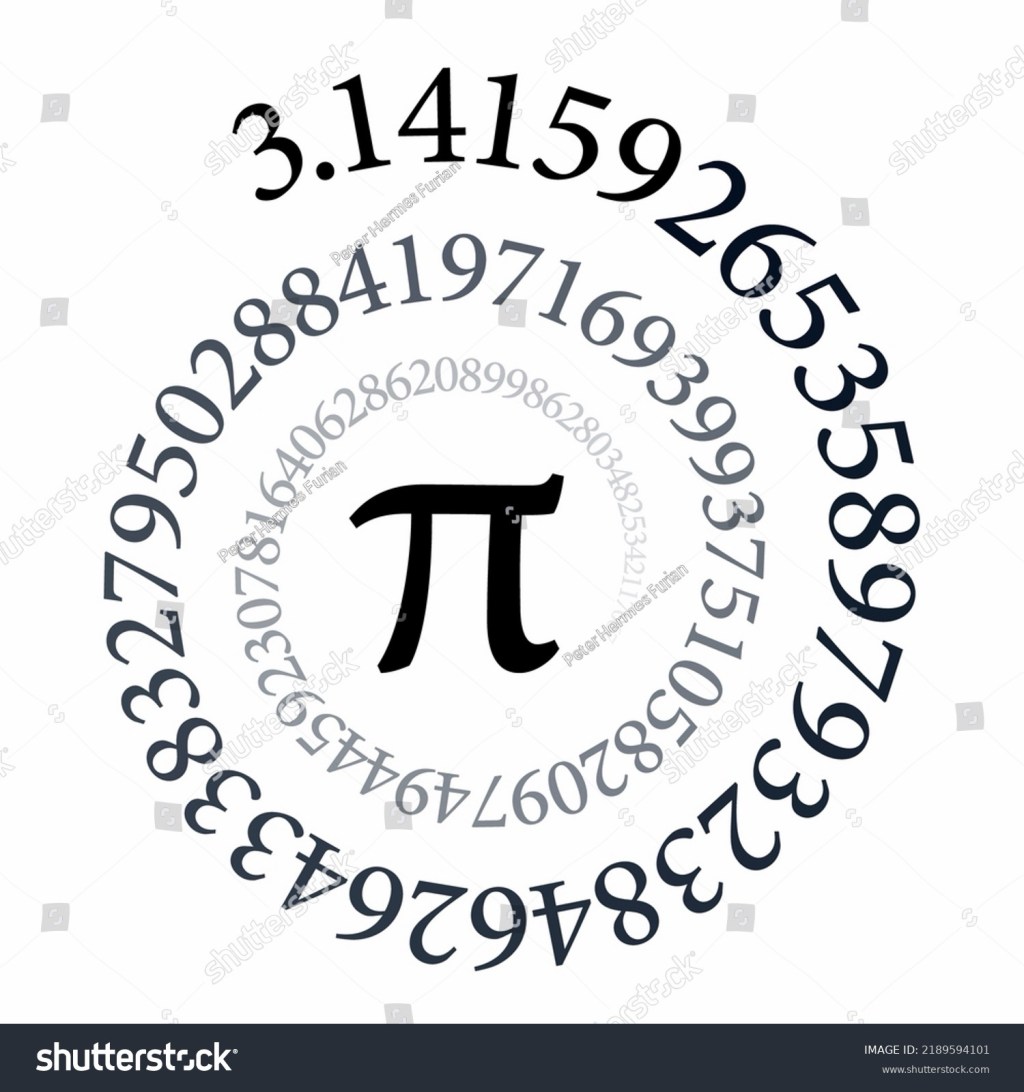
π (pi) is the ratio of a circle’s circumference to its diameter. No matter how large or small the circle is:
[ \pi = \frac{\text{circumference}}{\text{diameter}} ]
Its value is approximately:
[ \pi \approx 3.141592653589793… ]
and the digits continue forever without repeating.
How can you calculate π?
There are many ways:
1. Measure a circle
- Measure the circumference (C)
- Measure the diameter (D)
- Compute (C/D)
For example, if:
- Circumference = 31.416 cm
- Diameter = 10 cm
then:
[ \pi \approx \frac{31.416}{10} = 3.1416 ]
2. Use geometry (Archimedes’ method) Over 2,000 years ago, Archimedes drew polygons inside and outside a circle. As the number of sides increased, the polygon perimeter approached the circle’s circumference, giving increasingly accurate estimates of π.
3. Use infinite series One famous formula is:
[ \pi = 4\left(1-\frac13+\frac15-\frac17+\cdots\right) ]
This works, but converges very slowly.
4. Use modern algorithms Computers calculate trillions of digits of π using advanced algorithms such as the Chudnovsky formula.
Could you change the value of π?
In our universe, no.
π isn’t a physical constant like gravity or the speed of light. It’s a mathematical consequence of Euclidean geometry. Once you define a flat plane and a circle, π automatically has its value.
Changing π would be like changing what “2 + 2” equals. You would have to change the underlying mathematical rules.
But there is a way π can be different
In curved geometries:
- On a sphere, the circumference of a circle is less than ( \pi d ).
- In hyperbolic geometry, the circumference is greater than ( \pi d ).
For example, on the surface of a planet, very large circles do not obey Euclidean geometry exactly, so the ratio (C/D) is not exactly 3.14159.
In that sense, you don’t change π itself, but you change the geometry of space, and the circle measurements behave differently.
So the short answer is:
- Calculate π: measure circumference ÷ diameter, or use geometric/analytic formulas.
- Change π: not within ordinary mathematics. You would need to redefine the geometry or the mathematical rules that define circles.
So Says Copilot


Leave a Reply